
For marketers adrift in a sea of media fragmentation, sports have remained a dependable — if pricey — anchor, representing one of the few remaining pillars of monoculture. Look no further than the Super Bowl, which continues to draw record ratings and diverse audiences on linear TV despite the acceleration of cord-cutting.
That said, sports are as dynamic and fast-changing as other content types, and deep-pocketed companies like Unilever are adjusting their marketing strategies to recognize growing digital- and social-first consumption habits. The CPG giant’s broad spend on U.S. sports marketing nearly doubled between 2024 and this year, with further activity planned for 2026.
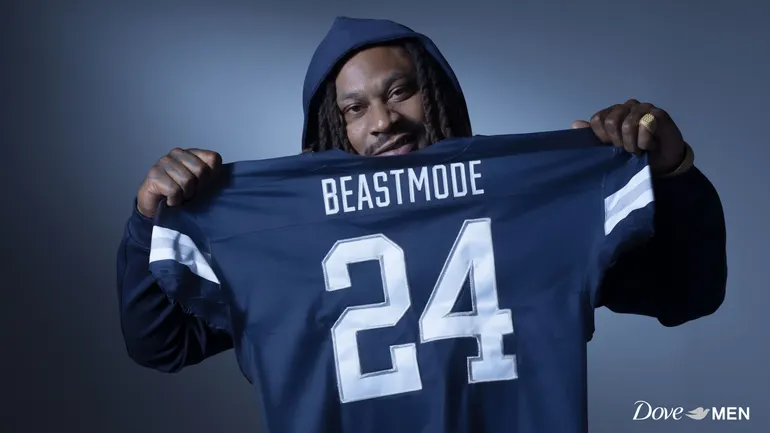
As part of its sponsorship of FIFA World Cup 26, for instance, Unilever’s Dove Men+Care personal care brand recently launched a campaign wherein former NFL player Marshawn Lynch attends a “super fan training camp” with U.S. soccer star Trinity Rodman, bridging two different interpretations of football with humor. The effort, running primarily on Meta and TikTok, promotes a sweepstakes to secure tickets to the highly coveted tournament, which will be played across North America starting in June.
“In principle, this is the biggest spectator event in all of history,” said Ryu Yokoi, chief media and marketing capabilities officer of Unilever personal care and North America, of the World Cup.
Unilever sees occasions like the World Cup as emblematic of a larger shift from one-to-many broadcast marketing — historically, a bedrock for CPGs — to “many-to-many” marketing that can reach fans at all levels and occasions. Unilever’s broad mandate is to build “desire at scale” for its brands, which are battling factors like price-sensitive consumers and upstart CPG disruptors, all while their parent company undergoes a wide-ranging restructuring. CEO Fernando Fernandez in March stated Unilever would allocate half of its total ad spend to social media while increasing work with influencers 20 fold. Many of those tactics are already apparent in how the CPG tackles a diversifying field of sports marketing.
“There are few things that carry this kind of focused attention, where so many are watching, and yet also the pockets are there in terms of cohorts, communities within it that are enjoying and engaging with (sports) from different angles,” said Yokoi, describing sports as an “ever-more important play.”
Social-first sports marketing
Unilever has invested in sports sponsorships for years but has been stepping up its presence in ways large and small to connect with different consumer groups and take advantage of evolving digital capabilities.
Hellmann’s made its Super Bowl debut in 2021 in what Yokoi described as a step-change moment, while Dove has appeared at the last two big games to promote messages around body confidence and keeping young girls involved in sports. Those are tentpole advertising opportunities — 30 seconds of Super Bowl airtime can command price tags over $7 million — but it is work that is increasingly supported by a steady clip of social and digitally oriented activations.
Take Hellmann’s, which has capitalized on viral moments like Tennessee Titans quarterback Will Levis boasting of putting mayonnaise in his coffee. Hellmann’s quickly formed a long-term partnership with the NFL athlete that has featured everything from a mock press conference addressing Levis’ unusual beverage routine to a “parfum de mayonnaise” gag fragrance and accompanying faux-luxury campaign.
https://www.youtube.com/watch?v=TPRTAcFIFQ8
The social-first mandate extends to user-generated content as well. For its sponsorship of the 2025 U.S. Open, Dove put out the call for an “underarm ambassador” to create TikTok content around the tennis tournament and promote antiperspirant products, highlighting a typically unglamorous part of the body. The U.S. Open activation echoed a larger platform where Dove has sought to bring fresh hygiene to events where sweating and B.O. runs rampant, like comic-book conventions and music festivals.
Unilever does not have a specific criteria for when to jump on trending social moments, according to Yokoi, but instead tries to situate those opportunities within its “brandverse,” or the way it maps brands onto stories that amplify specific product values and characteristics. If the social play can be extended into other channels like experiential marketing, all the better.
“One of the things we’ve been experimenting with more and more that we love is this idea of mixing social and IRL moments,” said Yokoi. “We find that that can be a real accelerator for this many-to-many idea.”
Bridging brand building and performance
The gravitation of sports to streaming is also attracting more investment from Unilever as it looks to tie marketing closer to conversions, or what Yokoi called a “culture to cart” strategy. Unilever was an early partner with Amazon on audience-based creative tools that allow brands like Dove to better tailor ads to households based on geographic, demographic and behavioral data.
Amazon’s ability to wed retail media muscle to an expanding slate of premium sports content, including NFL “Thursday Night Football” and regular-season NBA Games, has given it a first-mover advantage and helped propel massive growth for its advertising business. The approach is being replicated elsewhere in retail through deals like Walmart’s acquisition of Vizio, which will increase the big-box store’s advertising screen presence.
“Streaming has opened up a full digital playbook for us in what used to be a linear transmission,” said Yokoi.
https://www.youtube.com/watch?v=6IxFsKqxLRA
Despite the emphasis on performance marketing tactics, Unilever is preserving a commitment to purpose-driven messaging at the top of the funnel, including during moments like the Super Bowl. For the big game this year, Dove ran a spot highlighting how many young girls abandon sports due a lack of body confidence, an issue the personal care brand has tried to combat for decades. The heart-tugging commercial scored accolades for its emotional impact, but also reached incremental audiences, such as dads who serve as coaches for youth leagues.
“We have to look at both the short-term and the long-term impacts of this stuff in terms of the equity that we’re building and also, in the short term, the real drive to sale that’s happening in those windows,” said Yokoi. “We generate a ton of merchandising around these events and it’s really important that we sell through for our customers, our customers being the retailers.”